
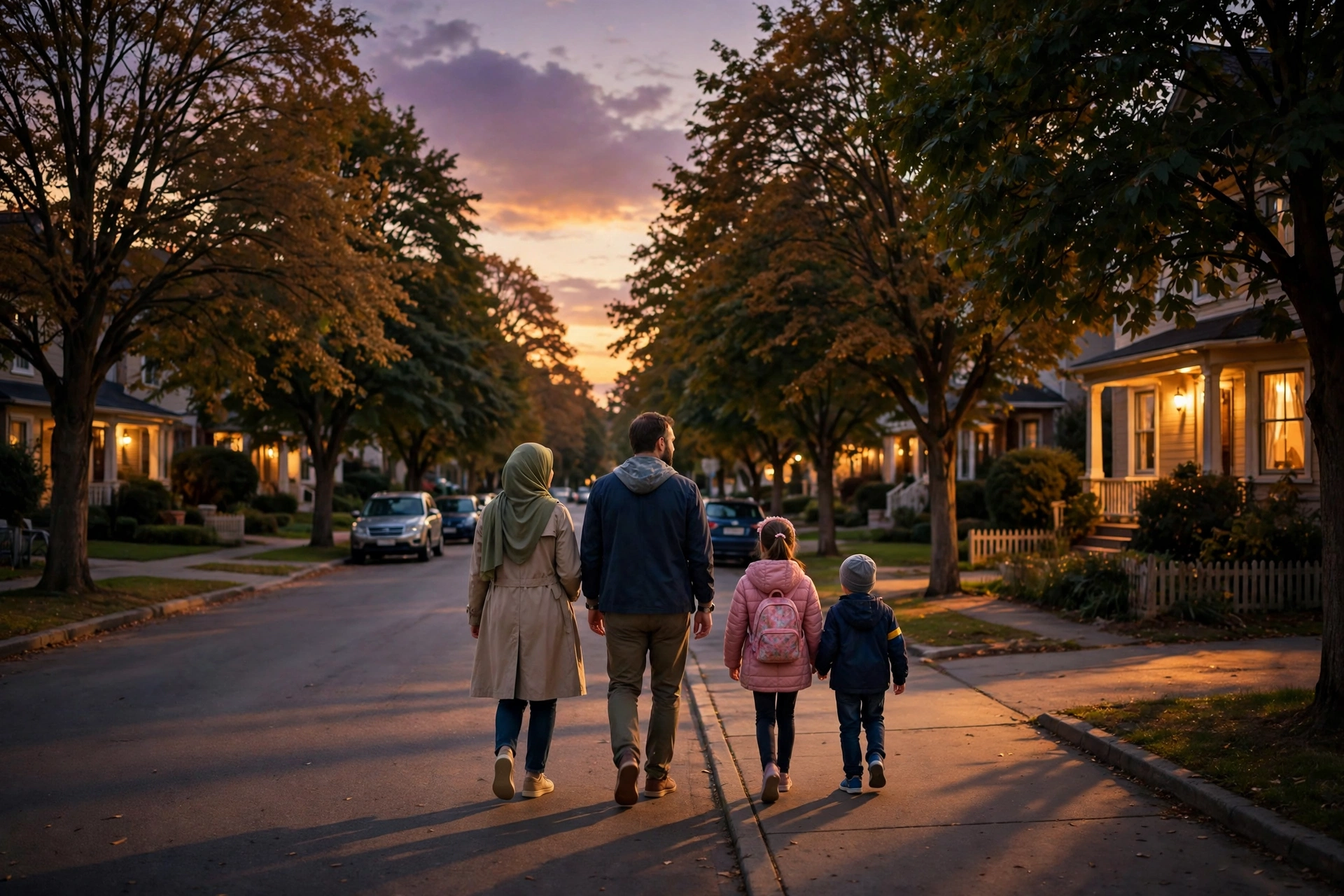
The Walk After Maghrib That Became Our Family's Best Conversation
A short walk after Maghrib, most evenings, with no destination and no agenda: ten minutes side by side is when our kids finally start talking, and the habit costs nothing but a pair of shoes by the door.
The ten minutes nobody planned
It started on an evening when dinner had run late, the dishes were still in the sink, and nobody felt like sitting down for another round of questions about homework. Instead of asking the kids how their day went for the third time, we put on our shoes and stepped outside. Maghrib had just passed, the sky was turning that deep blue-purple color, and the street was quiet except for a dog barking two houses down. We walked to the corner and back. It took ten minutes. On the way home, our daughter told us about a girl at school who had shared her lunch with a new student. She had not mentioned it at the table. She mentioned it on the sidewalk.
That is the whole idea, and it is a small one: a short walk after Maghrib, most evenings, with no destination and no agenda. It is not exercise, it is not a lesson, and it is not a family meeting. It is ten minutes of moving side by side, and somehow that is when the real talking happens.
Why walking works when sitting down does not
At the dinner table, everyone is facing each other, and a question can feel like an interview. On a walk, everyone is facing the same direction. There is a tree to look at, a cat to point out, a crack in the sidewalk to step over. The pressure drops. A child who gives one-word answers at the table will often start talking two houses down the street, simply because the conversation has somewhere to go besides straight at them.
Walking also gives fidgety kids something to do with their bodies. A younger child can count the porch lights that are on, or collect a leaf for the windowsill. An older child can walk a few steps ahead and still be part of the group. Nobody has to make eye contact to stay in the conversation, and that matters more than most of us realize, especially for teenagers, who would rather talk to the air in front of them than to a parent staring at them across a table.
Keep it short and keep it regular
The walk works because it is short. Ten minutes is enough. Fifteen on a mild evening is plenty. The moment it becomes a long march, the kids will start negotiating, and the habit will die within a week. Pick a loop that fits your street: to the corner and back, once around the block, down to the masjid gate and home if it is close. The same loop every time is a feature, not a flaw. Children like knowing where the walk ends, and parents like not having to decide.
Regularity matters more than perfection. Some evenings it will rain, someone will be sick, or dinner will simply run too late. Skip it and go again tomorrow. The habit is built by the evenings you do walk, not ruined by the ones you miss. If Maghrib is very early in winter, walk right after prayer while there is still a little light. If it is late in summer, walk after the dishes are cleared. The clock matters less than the rhythm: prayer, shoes, street, home.
What to talk about, and what to leave alone
The best rule for the walk is that nobody has to report anything. Leave the school day alone unless a child brings it up. Leave the chores, the grades, and the reminders at the front door. The walk is the one part of the evening where a parent is not managing anything, and children can tell the difference immediately.
Instead, notice things out loud. The neighbor who planted tomatoes along the fence. The house that put up lights early. The smell of someone frying onions. The moon, when it is out. These small observations are not small talk; they are an invitation. A child who hears a parent wonder about something ordinary learns that ordinary things are worth talking about, and before long they start offering their own: a funny thing a teacher said, a game at recess, a worry they have been carrying since lunchtime.
When a child does bring up something hard, resist the urge to fix it before the next lamppost. Listen first, walk a little further, and let them finish. A walk gives a difficult topic room to breathe in a way a kitchen chair does not, because there is always somewhere to look while the words come out.
Making room for everyone
A walk with a toddler in a stroller, a seven-year-old on a scooter, and a teenager with headphones around their neck is not the tidy picture in anyone's head, and it still counts. Let the little one set the pace for part of the way, and let the teenager walk ahead if they want to. The point is being out together, not marching in formation.
If grandparents live nearby, invite them on a Friday evening. Older relatives often have stories that never surface at the dinner table but come out easily on a slow walk: what the street looked like when they were young, how they learned to ride a bike, the neighbor they still remember. Children remember these walks long after they forget the lectures.
For families in an apartment building, the same idea works on a smaller scale. Walk the long way to the corner shop, circle the block once, or stroll through the parking lot and back. The loop does not need to be scenic. It only needs to be outside, together, and unhurried.
When the weather says no
Some nights the rain is too heavy or the cold is too sharp, and the walk simply does not happen. On those evenings, the habit can shrink instead of disappearing: stand on the porch for two minutes and look at the sky together, or walk the hallway and the stairwell once if the building allows it. The point is the pause after Maghrib, not the mileage. A two-minute version keeps the rhythm alive until the weather turns.
Keep a pair of shoes by the door for each person, and a light jacket on a hook through the colder months. The fewer decisions between the prayer mat and the front door, the more often the walk happens. If you have to hunt for shoes and argue about coats, the evening will swallow the habit whole.
What changes after a few weeks
Nothing dramatic happens at first. Then one evening, a child starts talking before you reach the end of the driveway. Another evening, they ask you a question you were not expecting, something they have clearly been thinking about for a while. Slowly, the walk becomes the place where things get said, not because anyone announced it, but because it is the only time of day when nobody is asking for anything.
That is the real gift of ten minutes after Maghrib. It does not fix the busy evenings or the hard school weeks. It just gives a family a small, regular space where conversation can happen on its own, at walking pace, under a darkening sky. Put on your shoes, step outside, and let the street do the rest.




Related Articles in Family
How to Disagree at Home Without Losing the Good in Each Other
Hospitality Does Not Need a Perfect House
A Bedtime Story Can Fit Even on a Busy Muslim Evening