
One Saturday a Month: Volunteering Together as a Family
One Saturday morning a month, our family sorts cans, carries boxes, and comes home a little different. Volunteering together needs no big plan, just a regular morning, a real job for every age, and a drive home with room to talk.
The Saturday we stopped sleeping in
It started with a flyer on the masjid notice board: the food pantry two streets over needed hands on Saturday mornings. We had talked about volunteering for years, in the vague way families do, usually while doing the dishes. One Friday night we finally said, tomorrow, nine o'clock, just this once. We woke the kids up earlier than usual on a weekend, which went about as well as you would expect, and we drove over with a box of rice and pasta from our own cupboard, because showing up empty-handed felt wrong.
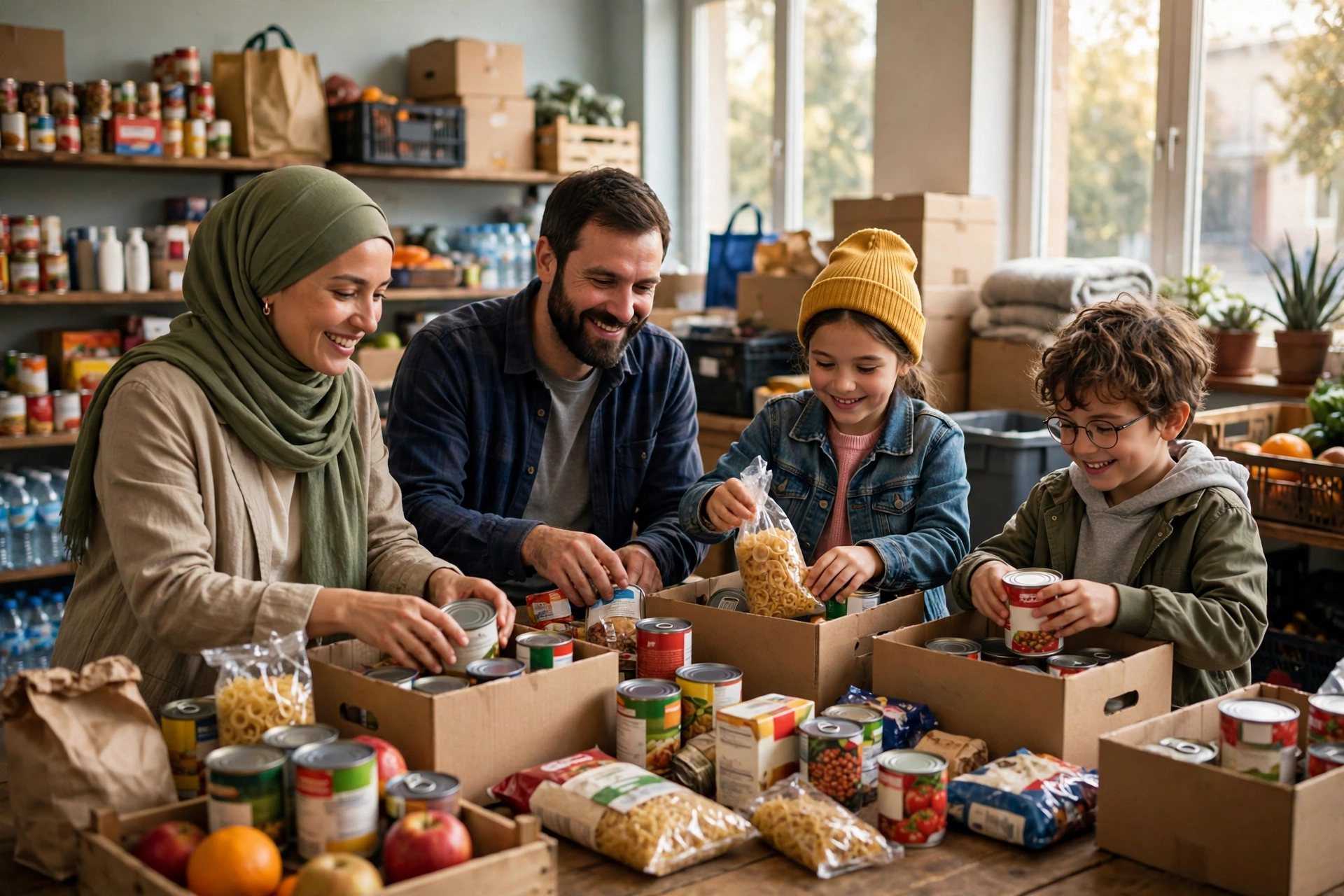
The pantry was a small room with long tables, shelves of cans, and a volunteer who handed our daughter a cardboard box and said, fill this one with pasta. That was it. No speech, no orientation, no big moment. For two hours we sorted donations, checked dates, and stacked boxes. Our son, who was seven at the time, appointed himself in charge of counting the cans in each box. On the drive home, nobody said anything profound. But at lunch, our daughter asked when we were going back. That question is why we kept going.
Doing teaches what telling cannot
Children hear a lot of good advice at home: be kind, share, look after your neighbours. Most of it slides off, because advice is abstract and childhood is concrete. A box of pasta is concrete. A shelf that needs restocking is concrete. A person who says thank you and means it is concrete.
Volunteering puts generosity into a child's hands instead of only into their ears. They lift something heavy and hand it to someone. They see that the food bank is not a place on the news, it is a room with a squeaky door and regulars who know the volunteers by name. They learn that helping is mostly ordinary work, done at an ordinary pace, and that ordinary work still counts. That lesson does not need a lecture afterwards. In fact, it survives better without one.
Start with one morning a month
The fastest way to kill a good intention is to make it big. A weekly commitment, a committee, a rota, a group chat: all of it can wait. One Saturday morning a month is enough to become a habit, and small enough to survive a busy season.
Pick one place and stick with it for a while. A food pantry, a park cleanup, a community garden, a masjid kitchen on a weekend, a library sale: any of them will do, and the nearest one is usually the right one. Call or ask in person first, and say plainly that you are a family with children and you would like a job everyone can do. Most places will have one ready, because family volunteers are the ones who come back. Keep the shift short, two hours at most, and leave while everyone still has energy. The goal is a morning your children remember fondly, not a shift they dread.
Fix it to a day you can remember without a calendar: the first Saturday of the month, or the Saturday after payday, or whatever fits your household. Regularity is what turns a nice day out into a family habit. If a month gets skipped because someone is ill or away, that is fine. A skipped month is not a failed habit. Go again next month.
Give every age a real job
Children can tell the difference between a real job and a pretend one. A four-year-old who is asked to sort the small cans from the big cans is working. A four-year-old who is told to sit in the corner with a colouring book while the adults work is waiting. The first one comes back next month. The second one asks to stay home.
Little ones are good at sorting, counting, and carrying the light things. They can put labels on bags, line up boxes, and hand things to the next person along the table. School-age children can check a list, pack a box to a pattern, and greet people at the door. Teenagers can carry the heavy boxes, run a small station on their own, and keep a younger sibling busy. If a teenager is allowed to bring a friend, the morning gets twice as easy, and the friend's family sometimes starts coming too.
Let the children see the whole job, not just their corner of it. Walk them through the room when you arrive: here is where the food comes in, here is where it gets sorted, here is where it goes out. When a child understands the chain, their small task stops feeling small.
When it is boring, awkward, or hard
Not every morning feels meaningful. Sometimes the room is cold, the boxes are heavy, and a child is bored within twenty minutes. Sometimes a teenager is embarrassed to be seen volunteering, or a younger child asks a question that makes an adult flinch. These are not signs that the idea has failed. They are the normal texture of doing something real with children.
When boredom hits, shrink the task, not the morning. Give the bored child a different job, a shorter one, or a partner. When a teenager is self-conscious, let them work at the back table for a while, where nobody is watching. When a hard question comes up on the drive home, answer it simply and honestly, and leave room for the next question. The drive home is the best part of the morning for talking, because nobody has to make eye contact and the conversation can wander. Ask one small question, not a quiz: what did you notice today? Then listen to the answer, even if the answer is that the biscuits ran out.
The small ritual after
Every habit needs a small reward that belongs to the habit itself. Ours is breakfast on the way home: the same bakery, the same table by the window, and the children order for themselves. It takes twenty minutes and costs very little, and it is now as much a part of the morning as the pantry is. On the months we skip volunteering, the children still ask about the bakery, which tells you something about how habits hold on.
Your ritual can be anything that fits your family: a walk in the park, a hot chocolate, a stop at the library. The point is that the morning ends the same way it started, together, unhurried, with something to look forward to. Children remember rituals long after they forget the details of the work.
What a year of Saturdays adds up to
After a year, the change is not dramatic, and that is the point. Nobody in our family became a different person. But the children know the pantry volunteers by name now, and the volunteers know them. Our son counts cans without being asked. Our daughter asks what the pantry is short of before we go, and puts it on the shopping list herself. They have started noticing needs closer to home, too: a neighbour's bin that needs bringing in, a classmate who forgot lunch, a new family at the masjid who might like an invitation.
That is the quiet gift of a regular morning of service. It does not make a family extraordinary. It makes the neighbourhood a little more familiar, and the children a little more certain that they belong in it, and that they can be useful in it. One Saturday a month is all it took to start.





Related Articles in Community
At the Masjid Potluck, Keep the Ingredients Beside the Dish
A Masjid Gathering Can Make Room for More Than One Way to Join In
Before the Open House, Make Room for Every Guest